
Postcards: A dark little tale as the evenings draw in
Peter Bullivant was hanged November last, and there was nothing I could do about it.
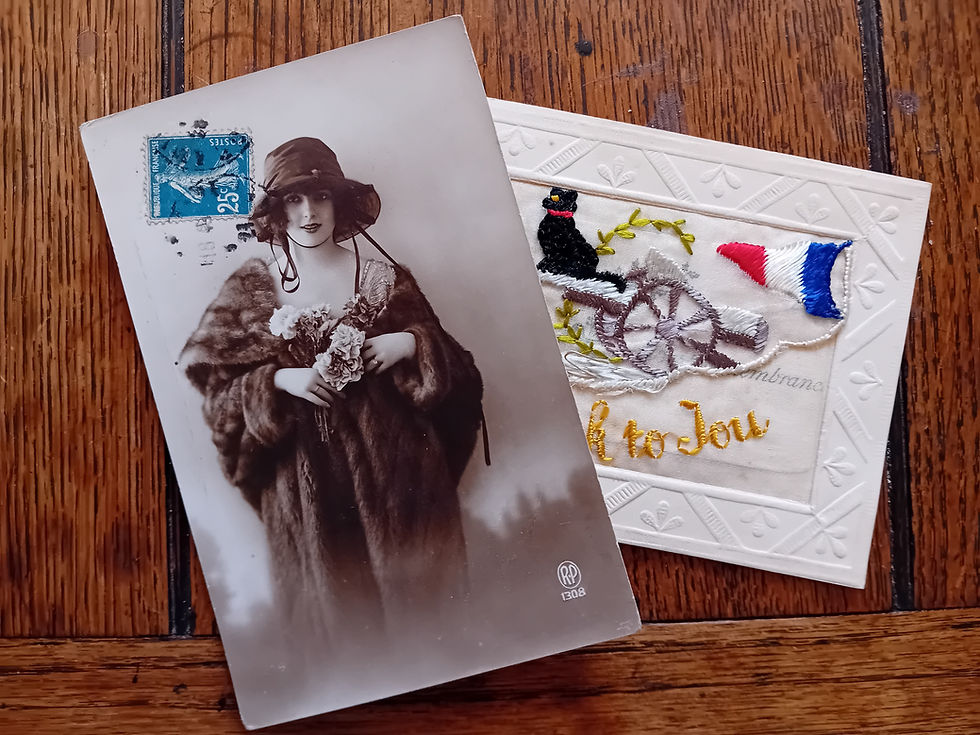
They let me go home a week afterwards, the Matron giving me an unexpected rustling pat on the shoulder and exhorting me to send her a nice postcard. I stood on the step in the November rain, while the railings glistened and the cabs growled past in trails of flying water, thinking of looped handwriting and casual promises. I shivered.
I dislike postcards.
The French embroider them, stitched with fat pink and green flowers or crossed flags, equipped with little lace pockets holding a printed sentiment. They whisper to me of false optimism, of dying men, lives frail as their thin translucent paper envelopes. I can imagine little Elspeth now, her hair falling out from under her nurses' cap in a dark curtain, her lips pursed as she kept her pen exact, transliterating some last gasped desolate message into politeness in the same way I might scrawl on a death certificate 'Died of Wounds'.
But Peter Bullivant did not die of his wounds.
He made the long soaked hike up to our dressing station a few times, after one or another of his men, a personable enough young officer who by the ever-darkening circles under his eyes was taking things hard. I probably looked the same. We shared a quick glass of whisky once as a secret pact, but I paid no real attention until one day he fainted, grabbing hold of a table and nearly upsetting it, rattling the instruments and spilling my papers.
We loosened his collar and we sat him down. Slowly he started to talk, looking at the table and fiddling with his silver-handled pocket knife, flicking the blade out and folding it back, turning it in his hands. He spoke about responsibility and abandonment. Not with those words, mind. He was no orator. One of those wounded young men was on his mind. I judged him stretched beyond his ability to cope, and administered a generous further ration of whisky. But it seemed to me, as we sat there talking together, that Elspeth's interest was more medicinal.
After that he came by a few times without a reason. Many times. He looked a little better. Elspeth vanished for minutes from her duties and I heard them talking together, their evident fondness blossoming grotesquely between slop buckets and men's cries of pain. I heard her low voice whispering through the canvas as if in prayer against shells and mud and random devastation. “Yes,” he replied, and it sounded like “Amen.”
But eternity for them did not exist. The last time, he was brought in on a stretcher with his left foot blown off, and I patched him up and sent him back to England, surprised at my own distress. I caught Elspeth in tears over a postcard, and I left her there alone.
Not until '24 did I see him again, in December in the Strand, a smart cane in one hand and my cousin Felicity clutching his other arm, a possessive, delighted, feather duster of blonde hair and layered coats. Our meeting ended in tea at the Strand Palace Hotel and my congratulations at their engagement, and after that old Peter was family.
It mattered, that, for my other family were distant, almost suspicious. 'Had a bad war,' I heard my uncle mutter to his friends, as I ranged around the dull room like an unwalked dog. Had he never himself been restless? Did he think my hearing unsound, or underestimate the range of his own voice, or did he not care? In the name of Christ, we all had a bad war. Like a lady's cigarette in a jade holder, we hold it far away as ever we can and yet we never let go of it at all.
Certainly Peter and I talked of it only on the most superficial level. I was aware once or twice when he spoke of it indirectly. A long roundabout anecdote of a school rugby match brought him back to his old worrying at abandonment, of disloyalty. The tale was boring, reassurance easily given, but I watched his earnest face leaning forward as he explained, watched it intently. Felicity should have had his confidence, not me. He felt my disengagement, and we broke off into another glass of whisky, drank more coffee, until at last she returned from her evening on the town, flushed and sketching crazy dances for our amusement. At last she collapsed in Peter's lap, both of them laughing. I took my leave then. There are many ways to have trust in someone, after all.
Another evening I was waiting for them both, an evening in late October. The weather outside was dank and spiteful, and the lights threw only small splashes into the face of the darkness. I wandered around Peter's study, fidgeting, and tried to straighten a drawer. It was jammed in sideways, and I tugged at it.
Old correspondence spewed out onto the carpet. I crammed it back, swearing, black edged funeral notifications, cabinet cards of old ladies sat square to the camera in malevolent hats, and a bundle -a substantial bundle tied with frayed string- of a handwriting I recognised, tidily looped with a sharp right-hand swerve at each tail. Many times I had read the notes of long nights in that hand, and a smell washed up to me from the paper of disinfectant and paraffin lamps, old mud and new decay.
I heard the front door. Whatever Elspeth had written to Peter, I thrust it back in the drawer. She had died in a bombardment. It was nothing to do with me.
“Hello?” called Felicity, shrugging off her coat. She glanced down at the floor. “What's this?” she asked.
She picked it up and held it out to me. I had missed one of the postcards from the drawer. “Is it yours?” she asked. I looked down at Peter's handwriting, not Elspeth's. “Always,” he had written. That was all.
I told her it wasn't mine, and thrust it illogically into my pocket.
“Don't you have a home of your own to go to?” she said. “Every time I come back, you're here again. It isn't you that Peter's marrying.”
I felt the scarlet flush creep up my neck and I took my leave as if I had not heard.
Back in my flat, I took out the postcard Felicity had given me. Just that one impossible word blazoned across it, and the thing was postmarked. Peter had sent it from England. It must have arrived within days of Elspeth's death. How had it found its way back here again?
I tried to stay away. Was it for Peter's sake, Felicity's? For mine? A sensation of doom had fallen over me, and I walked along the Thames in the dark, long walks out to the east. The scent of the mudflats rose up to me like Elspeth's scent, the odour of the Somme. She rose shattered before me in the dawn, abandoned, and I blinked until the sodium flare of the lights and the rippling docks were naked.
I threw away the postcard, and found it the next day again in with my mail, fresh muddy smears disfiguring the word, the accusation. “Always.”
The last evening, I stood on Peter's doorstep again.
The house lay quiet. Quiet, but unsettled and aware, as if more or less time had passed than the grandfather clock in its alcove in the hall believed possible. The front door swung aimless against the sodden night, and the same old stink, the rot and paraffin, the mud, wafted back at me from the street. “Elspeth,” I called from the top of the steps, and I saw, I swear I saw that curtain of dark hair, that trim gait, perhaps a little slow and hesitant, away at the end of the street, turning the corner. “Elspeth!”
She was not there. The house drew me back into its silence, the unlit sitting room where Felicity lay, her head flung back, her mouth open, a sliver gleam in the patched darkness. Peter knelt beside her, and I took up his old pocket-knife.
“I've not seen that since France,” he said, eyes staring, face set, “I gave it-”
“To Elspeth,” I finished for him, nodding, and a terrible puzzlement passed across his features. “She was here,” I carried on, “she did this. I saw her.”
“Henry,” he said, and he took me by both shoulders. He took the knife from me. “Henry, she's dead.” And I saw, at that moment, how it would go, when I stood in the witness box and I tried to explain, and the murmur came up from the court, and still Peter wore that wretched fixed look of obduracy, and I walked down on the hollow wooden steps, tap, tap, tap, with the crowd edging away.
There was nothing I could do.


Comments